
The Luddites were not wrong to be afraid. They were failed — and the answer nobody gave them is one we can give ourselves.
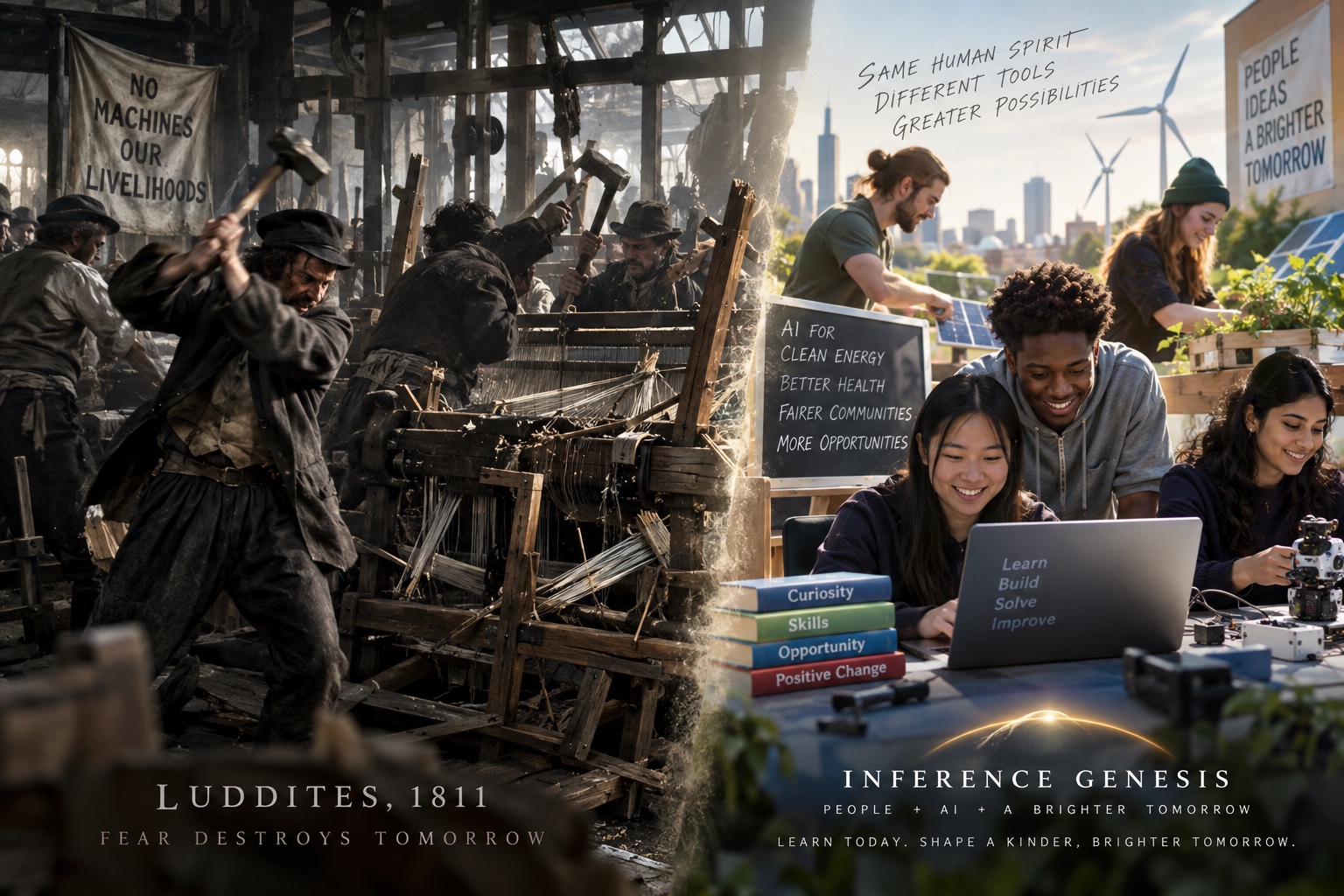
Same human spirit. Different tools.
Both halves of this picture are the same people. That is the first thing to notice about it, and the hardest.
On the left it is Nottingham, and the year is 1811. The frames arriving in the mills were faster than any weaver, cheaper than any weaver, and needed almost none of a weaver's skill. The men breaking them were not stupid and they were not superstitious. They had done the arithmetic, and the arithmetic said their trade was finished. It was. Their craft did die, the cloth did get cheaper, the country did get richer — and not one of them was ever made whole.
That is the part worth carrying forward. The Luddites' mistake was not a fear of machinery; it was reaching for the only lever they had, which happened to be a hammer. The larger mistake belonged to everybody else, who watched a few thousand families absorb the entire cost of a gain the whole country banked. Nobody built them a bridge.
We know how to build one now, and it is ordinary economics rather than prophecy. Retrain people before the job goes, not after. Insure the wage while they learn, so that learning is not a punishment. Share what the machine makes — the eight-hour day and the five-day week were exactly that surplus, handed back once before. And protect the person rather than the job title, with cover that follows a human being instead of an employer.
Those three need governments and employers, and we hope they take their part. The fourth needs nobody's permission, and it is the right-hand side of this picture. Learn how the thing actually works. Build one yourself — small, honest, and entirely yours. Artificial general intelligence is coming. We are not going to stop it, and on balance we would not want to. We can own it.
Don't smash the loom. Own one.
Nobody Built the Bridge
The Webspinner Foundation · 6:41
What this film argues
The Luddites were not wrong to be afraid. They were failed — and the answer nobody gave them is one we can give ourselves.
An honest account of what generative AI can and cannot do, why the noise around it is about something else, and the answer nobody gave the Luddites.

The right-hand side of the picture
You can build one this afternoon
Everything in this film was measured on a model small enough to train on a laptop in a minute and a half — the corpus counts, the thirteen per cent, the six characters it is still torn between. That model is not a demonstration we built to make a point. It is the one the course teaches you to build, and the numbers are yours to check.
Start at the command line, or start by clicking. Either way you finish holding a file that is a language model, on your own machine, that nobody can switch off.